
High-Altitude Filming in Nepal’s Extreme Locations
High Altitude Filming Nepal
Production Where the Air Gets Thin
Filming at high altitude is not simply filming in a beautiful location.
As altitude increases, the environment changes everything around the production. People, equipment, batteries, transport, communications, weather, access, working hours and emergency planning all become more demanding.
Nepal offers some of the world's most extraordinary high altitude filming environments, from the high valleys and mountain settlements of the Himalayas to glaciers, passes, expedition routes and landscapes surrounding some of the highest mountains on Earth.
Location Nepal provides high altitude filming and photography production support for international films, documentaries, television, commercials, natural history productions, editorial assignments, conservation projects, research, adventure productions and other professional visual projects.
Our role can begin well before the crew reaches the mountains.
We can help assess locations, understand the practical realities of working at altitude, develop field logistics, coordinate local teams, plan equipment movement, arrange accommodation and transport, support permits and access, and build appropriate health and safety considerations into the production.
The creative requirement remains central throughout.
The objective is not simply to reach a high location and record it.
It is to make professional images there while managing the realities that come with getting people and equipment safely into an environment where conditions can change quickly.
High altitude production requires experience on the ground, not just enthusiasm for the mountains.
The higher the production goes, the more important everything behind the camera becomes.
Experience at Altitude
Production Knowledge That Comes From Being There
High altitude work changes the way a production has to be planned. The distances that look manageable on a map can take considerably longer on the ground, weather can alter a schedule within hours, equipment that works perfectly in Kathmandu can behave differently in the cold, and the physical condition of the crew becomes part of the production equation. These are not things that can be understood properly from a generic location guide. They come from spending time in the field, understanding how the mountains work and knowing how quickly a seemingly straightforward filming plan can become complicated.
Gautam Dhimal has spent much of his career working across Nepal's varied terrain as a photographer, filmmaker and producer, including remote mountain environments and demanding field assignments. His experience extends beyond operating a camera. It includes production planning, location scouting, logistics, aerial photography, remote access, local coordination, equipment management and working with international crews where timing and preparedness matter.
That experience is supported by Location Nepal's wider network of local professionals, field specialists, photographers, researchers, guides, drivers, fixers and production crew who understand different regions and working environments across the country.
For an international production, this local knowledge can make a substantial difference. We understand that the mountain is not simply the backdrop. It determines where the crew can stay, how equipment gets there, how long people can work, what can realistically be achieved in a day and what needs to be planned before anyone leaves Kathmandu.
The aim is to bring that understanding into the production from the beginning rather than trying to solve mountain problems after the crew has already arrived.
High altitude experience is ultimately about knowing what the mountains will ask of a production before the mountains ask it.
Planning for Altitude
The Production Has to Move at the Pace of the Mountain
One of the easiest mistakes in high altitude filming is to plan the mountain section of an assignment as if it were simply another location on the schedule. A crew may be perfectly capable of working long days at sea level, but altitude, cold, terrain and limited access change what is realistic. Walking a short distance with camera equipment can become physically demanding, locations may take much longer to reach than expected, and weather can remove an entire filming window without much warning.
We build the production schedule around those realities.
Depending on the altitude and nature of the assignment, planning can include gradual ascent, acclimatisation time, realistic working days, rest periods, equipment movement, porter or local support, accommodation, transport and contingency days.
We also look at the sequence of the production as a whole. It may make sense to complete certain work at lower elevations before moving higher, to position equipment in advance, or to use different crew arrangements at different stages of the assignment.
This is particularly important when an international crew has limited time in Nepal. A schedule that looks efficient on paper can become inefficient very quickly if it does not account for the actual conditions on the ground.
We therefore prefer to build a practical field schedule first and then determine what can realistically be achieved within it.
Sometimes that means fewer locations and more time at each one. Sometimes it means splitting the crew or using local support. Sometimes the original idea needs to be changed.
The important thing is that these decisions are made before the production is standing at altitude with cameras ready to roll.
The mountain sets the pace. Good production planning learns to work with it.
Health, Safety & Emergency Preparedness
Looking After the People Behind the Production
At altitude, the wellbeing of the crew cannot be separated from the work. Fatigue, cold, dehydration, altitude related illness, changing weather and difficult terrain can affect judgement and performance as well as physical health. A production that ignores those realities can quickly put people and equipment under unnecessary pressure.
We therefore consider health and safety as part of production planning from the beginning.
Depending on the location and altitude, this can include:
Altitude and acclimatisation planning
Pre field medical considerations
First aid arrangements
Medical support
Emergency communication
Evacuation planning
Rescue coordination
Weather monitoring
Route assessment
Appropriate vehicles
Local field support
Emergency accommodation
Contingency days
Crew welfare
Equipment protection
The appropriate arrangements depend greatly on where the production is going. A filming assignment in a high valley with road access is very different from a multi day expedition involving remote trails, glaciers or isolated settlements.
We assess those differences before the field operation begins.
Emergency planning is also considered in practical terms. If somebody becomes unwell, if weather closes a route, if a vehicle cannot reach the crew or if equipment fails in a remote location, the production needs to know what happens next.
That does not mean assuming that something will go wrong.
It means making sure the production is not completely unprepared if something does.
The same thinking applies to equipment. Cameras, batteries, storage systems, communications equipment and other technical gear have to be protected from cold, moisture, dust, impact and the additional demands of transporting equipment through difficult terrain.
The best safety plan is the one that quietly does its job until the day it is needed.
Equipment & Technical Preparation
Cameras Have to Survive the Journey Too
Getting professional equipment to a high altitude location is only part of the challenge. It then has to keep working through cold temperatures, changing weather, dust, moisture, long days outside, difficult transport and sometimes very limited opportunities to recharge or replace anything that fails.
We plan equipment around the actual conditions rather than simply taking the same package used for a city production.
This can involve careful consideration of:
Camera bodies
Lenses
Batteries
Battery management
Memory cards
Data storage
Backup systems
Protective cases
Weather protection
Cold weather equipment
Tripods and support systems
Lightweight field equipment
Communications equipment
Drone systems where appropriate
Power and charging requirements
Weight becomes an important consideration as well. Carrying every possible piece of equipment may sound reassuring before a shoot, but unnecessary weight becomes a real burden when the crew is moving through steep terrain at altitude.
At the same time, reducing the equipment package too aggressively can leave the production without something essential when conditions change.
The balance comes from understanding the assignment before deciding what needs to travel with the crew.
Data management is equally important. A day's filming in a remote mountain location may represent material that cannot simply be recreated the following morning. Multiple copies, appropriate storage and a clear backup procedure therefore form part of the field plan.
Where equipment is being brought into Nepal by an international production, we can also help coordinate the practical production requirements around getting that equipment to the field and back again.
At altitude, every kilogram has a reason to be there. Every piece of equipment should earn its place.
High Altitude Locations Across Nepal
From Mountain Valleys to the High Himalayas
Nepal's high altitude environments are remarkably varied. A production may be working in a settled mountain valley with road access, a remote village reached on foot, a high mountain pass, a glacial landscape or an expedition environment where the logistics are completely different from anything available in the lower valleys.
We work with the production team to understand what the location actually requires before committing to a field plan.
Depending on the project, high altitude filming can involve:
Everest region
Annapurna region
Manang
Mustang
Dolpo
Humla
Langtang
Manaslu
Kanchenjunga region
High Himalayan valleys
Mountain passes
Glacial environments
Remote settlements
High altitude conservation areas
Expedition routes
The name of a region alone does not tell us enough to plan a production.
The exact location, season, altitude, access, road conditions, walking distance, accommodation, communications and local requirements all need to be understood.
A location that is accessible by road in one season may require a completely different operation later in the year. A village that looks close on a map may involve hours or days of movement with equipment. A high pass may offer an extraordinary filming opportunity but only a narrow window in which weather and visibility are suitable.
This is why location planning for high altitude filming is part of the production itself.
We can research locations before the crew arrives, assess practical access and build the filming plan around what the environment will realistically allow.
The location is only the beginning. The real production plan starts when we ask how we are going to work there.
Remote Access & Field Logistics
Getting People and Equipment Where the Story Is
In the mountains, getting to the filming location can sometimes be a larger production exercise than the filming itself. Roads may end long before the location, weather can interrupt flights, trails can change with the season and equipment may need to move through terrain where vehicles simply cannot go.
We plan the movement of the production as carefully as the filming schedule.
Depending on the assignment, this can include:
Domestic flights
Helicopter access where appropriate
Four wheel drive transport
Local vehicles and drivers
Porters and equipment carriers
Pack animals where appropriate
Local field assistants
Accommodation
Food and field supplies
Communications
Equipment movement
Route planning
Advance location checks
Local coordination
Contingency arrangements
For larger productions, equipment may need to move in stages, with certain material positioned ahead of the main crew. Local teams can also be brought in to help with transport, accommodation, community coordination and other practical requirements.
The logistics are developed around the production rather than added after the location has been chosen.
If the crew needs to reach several locations, we look at the most sensible sequence. If a location has limited accommodation, that becomes part of the schedule. If weather can affect a flight or mountain crossing, contingency time needs to exist.
The objective is to avoid wasting valuable filming days solving problems that could have been identified during pre production.
In high altitude production, every camera movement starts with a people and equipment movement plan.
Working With Mountain Communities
Local Knowledge Matters Long Before the Camera Arrives
Many high altitude filming locations are not empty landscapes. They are home to communities whose lives, work, culture and relationship with the mountains are often central to the story being filmed. Reaching a location does not automatically mean that a production understands how it should work there.
Our local production approach begins with understanding the place and the people who live there.
Depending on the assignment, this can involve local introductions, community liaison, translators, researchers, field assistants and people with knowledge of the particular region or subject.
This can be especially important for documentary, humanitarian, conservation, research and cultural productions where the relationship between the crew and the community matters as much as the images themselves.
We consider how the crew arrives, where equipment is placed, how filming is explained, who needs to be involved and how the presence of an international production may affect the community.
For sensitive subjects, additional care may be required around privacy, consent, children, cultural practices and the use of people's images.
Local knowledge also has a practical value. People living in the area often understand weather patterns, routes, seasonal changes, local access and conditions that cannot be learned from a map.
Our wider network allows us to bring together the right local knowledge for the particular assignment rather than assuming that one person can know every region of Nepal.
The mountains may be the location, but people are often the reason the production is there.
High Altitude Productions & Expeditions
Supporting Productions That Need to Go Further
Some filming assignments are built around an expedition rather than a conventional location shoot. The crew may be following climbers, scientists, conservation teams, mountaineers, researchers or a subject moving through remote terrain. In these situations, filming becomes one part of a much larger field operation and has to work within the rhythm of the expedition.
We can support productions where the visual team needs to operate in these conditions, helping integrate filming requirements into the wider field plan.
This can include:
Expedition documentaries
Mountaineering productions
Adventure films
Natural history projects
Scientific fieldwork
Environmental research
Conservation expeditions
Glacier and cryosphere documentation
Climate research
High altitude photography
Remote community stories
Humanitarian field assignments
Long form documentary projects
The production requirements can vary enormously. One project may need a small lightweight camera package carried by a compact field team. Another may involve a larger international crew, specialist equipment, multiple locations and extended time in the mountains.
We can help assess what the production actually needs and how those requirements can fit within the expedition structure.
This may include local production support, equipment planning, field logistics, location research, communications, local specialists and coordination with the wider expedition team.
The objective is not to turn an expedition into a conventional film set.
It is to make sure the filming operation is prepared well enough to work within the realities of the expedition without compromising safety, the objective of the expedition or the quality of the production.
In an expedition environment, the camera crew has to become part of the field operation, not an obstacle to it.
Aerial Imaging at High Altitude
When the Story Needs to Be Seen From Above
High altitude aerial work introduces another layer of complexity to an already demanding production. Thin air, wind, temperature, terrain, access and changing weather can all affect an aerial operation, while the location itself may have additional aviation or environmental considerations.
Where appropriate, drone photography and filming can become part of a high altitude production, providing perspectives that are difficult to achieve from the ground.
This can be useful for:
Himalayan landscape sequences
Glacial environments
Mountain expeditions
Remote settlements
Conservation projects
Environmental documentation
Research projects
Documentary establishing shots
Route and landscape context
High altitude still photography
The decision to use a drone is made as part of the wider production plan. We consider the location, conditions, permissions, safety, equipment requirements and the actual visual purpose before including aerial work in the schedule.
A drone can be particularly valuable when the production needs to show scale and relationship: a small human figure within a vast landscape, a settlement within a mountain valley, a glacier extending beyond the immediate viewpoint or the geography surrounding an expedition.
For productions requiring more extensive drone operations, the dedicated aerial production capability of Location Nepal can be incorporated into the assignment without making the high altitude crew responsible for solving every aerial requirement independently.
At altitude, an aerial shot is never simply another shot on the list. It is another operation that has to be planned properly.
Helicopter Access & Aerial Cinematography
When the Production Needs More Than a Drone
There are high altitude assignments where a drone is simply not the right tool. The location may be too remote, the operation may require greater range or endurance, the production may need to carry heavier camera systems, or the creative brief may require a level of aerial movement and stability that calls for a crewed aircraft.
For these productions, we can arrange helicopter based access and aerial cinematography in Nepal, including gyro stabilised aerial camera systems and experienced operators trusted by professional film and television productions.
Helicopters can also provide an important production advantage beyond filming. They can provide access to locations that would otherwise require long periods of walking or expedition logistics, allowing crews and equipment to reach difficult high altitude locations within a practical production schedule.
Depending on the assignment, the helicopter operation can support:
Aerial cinematography
High resolution aerial photography
Gyro stabilised camera systems
Heavier cinema camera payloads
Long lens aerial photography
Mountain and Himalayan filming
Remote location access
Expedition support
Natural history productions
Feature films
Documentaries
Commercials
Environmental and conservation projects
We can also coordinate the technical side of bringing specialist aerial equipment into Nepal.
If the required camera system is not already available locally, temporary import arrangements can be explored and managed as part of the production. Where an international production or client already owns or is bringing its own aerial equipment, we can assist with the local handling, customs coordination, documentation and related production logistics.
The objective is to make the helicopter operation part of a properly managed production rather than leaving an international crew to navigate the local process on its own.
When the image, the location or the camera requires a helicopter, we can build the operation around it.
High Altitude Production Teams
Building the Right Team for the Environment
The right crew for a high altitude production depends entirely on what the assignment is asking people to do. A small documentary team following a researcher needs a very different structure from a large international production filming an expedition, a commercial in the mountains or a scientific project over several weeks.
Location Nepal can build the local production team around the requirements of the assignment.
Depending on the project, this may include:
Field producers
Production managers
Location managers
Fixers
Local photographers
Cinematographers
Drone pilots
Aerial cinematographers
Camera assistants
Field assistants
Translators
Community liaison
Local researchers
Mountain specialists
Drivers
Equipment carriers
Medical and safety support
Specialist technical crew
Our wider professional network is particularly valuable when a production moves into a specialised environment. Different regions, subjects and technical requirements call for different knowledge, and we prefer to bring in people who genuinely understand the particular assignment rather than treating every high altitude production in the same way.
For international productions, we can also work alongside the visiting crew and fill only the roles that are required locally.
A production may arrive with its own director, cinematographer and camera department and simply need local field production and mountain support. Another may need a complete Nepal based team.
The structure can therefore remain deliberately lean or expand according to the scale and complexity of the work.
Good field production is often about knowing exactly who needs to be there, and equally importantly, who does not.
Preparedness & Contingency
The Backup Is Part of the Production
When a production has travelled across the world and spent days getting into a remote mountain location, losing a filming day because a battery fails, a piece of equipment stops working or the weather changes is not a small inconvenience. There may be no nearby rental house, no replacement equipment arriving in an hour and no practical way to simply return the next morning.
This is why we plan for more than the ideal scenario.
For demanding high altitude productions, preparedness can mean having equipment, people and practical alternatives positioned at different points of the operation.
Depending on the assignment, this may include:
Primary equipment
Backup equipment
Additional backup systems
Spare batteries
Multiple data storage systems
Alternative communications
Standby crew
Additional local specialists
Equipment positioned at the field location
Equipment held at a lower altitude or base location
Additional resources available in Kathmandu
Alternative transport
Contingency accommodation
Alternative filming locations
Weather contingency days
Alternative access arrangements
The idea is not to carry an unnecessary amount of equipment into the mountains.
It is to identify what could genuinely stop the production and decide beforehand how that problem would be handled.
Some backups can travel with the crew. Others can remain at a base location or in Kathmandu and be brought forward when required. The right arrangement depends on the remoteness, duration and importance of the assignment.
The same principle applies to people. If a particular technical specialist is essential to the production, we consider what happens if that person becomes unavailable. If a route becomes inaccessible, we consider the alternative. If the weather removes a planned filming day, we look at what other work can be completed instead.
This kind of preparation may appear invisible when everything goes according to plan.
That is exactly the point.
In remote production, preparedness is not an extra cost added to the shoot. It is often what saves the shoot.
High Altitude Support for International Productions
Bring Your Production to Nepal With a Team That Knows the Ground
International productions working in Nepal often arrive with a strong creative and technical team already in place. The challenge is everything that has to happen around that team once the production moves into the mountains. Routes, access, equipment movement, local personnel, accommodation, permissions, weather, safety and contingency all have to come together without taking the creative team away from the work they came to do.
Location Nepal can become the local production structure around the visiting crew.
We can begin working with the production during pre production, reviewing proposed locations and schedules and identifying what will actually be required to make the high altitude operation possible.
That may involve a relatively small local team supporting an international documentary crew, or a much larger production operation involving multiple locations, specialist aerial equipment, field personnel and extended time in the mountains.
We can coordinate with producers, directors, cinematographers, production managers and location departments and work within the production's existing systems wherever possible.
For productions bringing specialist equipment from overseas, we can also help coordinate local handling, customs and temporary import requirements and the movement of equipment into the field.
The visiting crew should be able to concentrate on the film.
Our responsibility is to make sure the Nepal side of the production is properly understood, prepared and managed.
And if something changes, we should already have thought about what happens next.
You bring the creative vision. We bring the local production knowledge, field network and preparedness to help execute it in Nepal.
Scientific, Environmental & Conservation Filming
Documenting High Altitude Environments for More Than the Picture
Some of the most important stories being documented in Nepal's high mountains are not simply about climbing or adventure. Researchers, conservationists, scientists and field teams are working in environments that are changing rapidly, studying glaciers, biodiversity, water systems, wildlife, ecosystems and communities whose lives are closely connected to the mountains.
These assignments require a different kind of production awareness. The camera team has to work around research schedules, scientific equipment, field protocols, sensitive locations and sometimes very limited windows in which the work can be carried out.
We can provide visual production support for projects involving:
Cryosphere and glacier research
Climate documentation
Environmental science
Biodiversity
Wildlife conservation
High altitude ecosystems
Water and watershed research
Mountain communities
Environmental change
Scientific expeditions
Conservation programmes
Academic field research
Long term visual documentation
Where specialist knowledge is required, our wider professional network allows us to work with researchers, conservation professionals, photographers, field specialists and other subject experts according to the requirements of the project.
The visual work can range from documentary filming and photography to aerial imaging, field interviews, location documentation and repeat photography designed to record change over time.
We also understand that research and conservation projects may have objectives beyond the final film. The imagery may become part of an archive, scientific communication, education programme, publication, exhibition or long term record.
That makes the field production and data management just as important as the individual images.
When the subject is a changing mountain environment, the value of the footage can extend far beyond the production that commissioned it.
Location Scouting & Advance Preparation
Understanding the Location Before the Crew Arrives
A high altitude location can look perfect in photographs and still prove completely unsuitable for the production once the practical details are understood. Access, walking time, available space, accommodation, weather exposure, communications, equipment movement and the position of the sun can all change how a location works for filming.
Where required, we can carry out location research and advance preparation before the principal crew arrives in Nepal.
This can include assessing proposed locations, identifying access routes, checking practical filming positions, understanding local conditions, researching accommodation and transport, identifying suitable base locations and determining what equipment and personnel will need to reach the site.
For productions with specific visual requirements, the scouting process can also consider the image itself. Direction of light, seasonal conditions, visibility, foreground and background, possible camera positions and the relationship between locations can all influence whether a place will actually deliver what the director or cinematographer has in mind.
Where a location is remote, advance preparation can save considerable time in the field. Equipment and supplies may be positioned ahead of the main crew, local support can be arranged, and alternative locations or access plans can be identified before the production begins its journey upward.
We can also work from references supplied by an international production and investigate whether a particular visual requirement can realistically be achieved in Nepal.
The purpose of advance work is not to remove all uncertainty from a mountain production. That is rarely possible.
It is to make sure that the uncertainty that remains is understood, planned for and manageable.
The more difficult the location, the more valuable it becomes to know something about it before you arrive.
Keeping the Production Moving
When Conditions Change, the Plan Has to Change With Them
Mountain productions rarely follow the original schedule perfectly. A flight may be delayed, a pass may become inaccessible, weather may close a location, a crew member may need additional rest, or a planned filming position may no longer be practical. The important thing is not to pretend these things will not happen. It is to have enough planning and local knowledge to respond without losing the entire production day.
We build flexibility into the operation from the beginning.
Where possible, filming schedules can include alternative locations, additional material that can be captured at lower elevations, flexible movement days and contingency time for weather or access problems.
If the principal filming location becomes unavailable, the team can assess what else can be achieved rather than simply standing down. Interviews, environmental details, secondary locations, establishing material, still photography, equipment preparation or other planned work may be brought forward.
The same applies to transport and equipment movement. If the original route changes, we look at alternative ways of getting the crew and equipment where they need to be.
For international productions working to tight schedules, this flexibility can make a significant difference. The objective is to protect the creative day wherever it is realistically possible to do so without compromising safety or the quality of the work.
A well prepared production does not necessarily have fewer problems.
It has fewer problems that come as a complete surprise.
The contingency plan is not the opposite of the production plan. It is part of it.
A Complete High Altitude Production Partner
From the First Conversation to the Last Day in the Mountains
A high altitude production rarely belongs to one department. The filming may be the reason for going into the mountains, but making it happen involves location research, permits, transport, accommodation, equipment, crew, specialists, communications, health and safety, aerial operations, data management and contingency planning. When these elements are handled separately, gaps can appear between them. When they are planned together, the entire production becomes considerably more manageable.
Location Nepal can coordinate these elements as part of one local production structure.
Depending on the assignment, we can support:
Pre production planning
Location research and scouting
Production management
Local crew and field teams
Specialist researchers and subject experts
Permits and local coordination
Transport and accommodation
High altitude logistics
Equipment movement
Camera and technical support
Drone operations
Helicopter access
Gyro stabilised aerial cinematography
Health and safety planning
Emergency and evacuation coordination
Backup equipment and standby resources
Data management
Field production
International crew support
Remote production support
The production can use as much or as little of this structure as it needs.
An international documentary team may need only location and field production support. A major natural history production may require a complete local operation with specialists, multiple crews, aerial cinematography and extensive logistics. A photographer may need a carefully planned expedition around a very specific visual objective.
We build the structure around the assignment rather than expecting every production to fit the same package.
That flexibility comes from having production experience across different types of work and a professional network that can be brought together according to the subject, location and technical requirements.
The mountain production is yours. Our job is to make the Nepal side of it work.
Frequently Asked Questions
High Altitude Filming in Nepal
What is considered high altitude filming in Nepal?
The requirements depend on the elevation, location, duration and nature of the production. Higher elevations introduce additional considerations around acclimatisation, weather, cold, access, communications, equipment and emergency planning.
Can you support international film crews at high altitude?
Yes. We can provide local production support for international feature films, documentaries, television, commercials, natural history productions, research projects, conservation work and photography assignments.
Can you help us plan a high altitude shoot before we arrive in Nepal?
Yes. Pre production can include location research, access planning, logistics, crew requirements, equipment planning, permits, accommodation, transport, safety considerations and contingency planning.
Can you scout high altitude locations?
Yes. We can research and scout proposed locations and assess practical filming conditions, access, camera positions, light, accommodation, transport and other production requirements.
Can you work in the Everest region?
Yes, subject to the specific location, season, permissions, access and operational conditions. Different parts of the Everest region present very different production requirements.
Can you work in Annapurna, Manang, Mustang, Dolpo, Manaslu and other remote regions?
Potentially, depending on the assignment and current access, permissions, weather and logistical conditions. We assess each location individually rather than treating an entire region as one production environment.
Can you arrange helicopters for high altitude filming?
Yes. Helicopters can be arranged for location access and aerial cinematography where appropriate. We can also coordinate specialist gyro stabilised aerial camera systems and experienced operators.
Can you arrange heavier aerial camera systems?
Yes. Where the creative requirement calls for a heavier cinema camera or specialised aerial system, we can explore the appropriate helicopter based solution.
Can international productions bring their own aerial equipment?
Yes. Where a production already has its own equipment, we can assist with local handling, customs coordination, temporary import arrangements and movement of equipment within Nepal.
Can you temporarily import specialist equipment into Nepal?
Where practical and subject to the applicable customs and import requirements, temporary import arrangements can be coordinated as part of the production.
Can you provide drone filming at high altitude?
Yes, where the location, permissions, weather, aircraft and operational conditions make it appropriate. Drone work is assessed as part of the wider production rather than automatically included in every high altitude assignment.
How do you handle altitude related health and safety?
We consider acclimatisation, crew welfare, altitude related risks, weather, emergency communication, medical support and evacuation planning according to the location and nature of the assignment.
Can you arrange emergency or helicopter evacuation?
We can incorporate emergency and evacuation planning into the production and coordinate appropriate local resources. The exact arrangements depend on location, access, altitude, weather and available services.
How much equipment should we bring?
That depends on the production. We help assess the creative requirements against the realities of transporting and operating equipment at altitude. The objective is to carry what is necessary while maintaining appropriate redundancy.
Do you provide backup equipment?
Backup requirements can be planned according to the importance and remoteness of the production. Additional equipment, batteries, storage and technical resources may be positioned with the crew, at a base location or in Kathmandu.
What happens if equipment fails in a remote location?
The response depends on the equipment and location, but contingency planning can include spare equipment in the field, additional resources at a lower altitude or equipment available in Kathmandu.
What happens if the weather stops filming?
We build contingency into the schedule wherever possible. The crew may move to an alternative location, work at a lower elevation, capture other planned material or use the time for preparation depending on the circumstances.
Can you provide local guides and mountain specialists?
We can bring appropriate local professionals and specialists into the production according to the location and subject. The requirement may vary from local field support to technical, scientific or conservation expertise.
Can you support scientific and research expeditions?
Yes. We can support visual documentation for scientific, environmental, cryosphere, biodiversity, conservation and academic field projects.
Can you film wildlife at high altitude?
Yes, where appropriate. Wildlife productions require additional consideration around animal behaviour, distance, access, season, conservation requirements and ethical filming practices.
Can you provide photographers as well as film crews?
Yes. High altitude photography can be commissioned independently or integrated into a larger film production.
Can you provide production support if we cannot send a full crew to Nepal?
Yes. We can build a local field production around your brief and coordinate filming, photography, aerial work, logistics and delivery according to the project requirements.
How far in advance should we plan a high altitude production?
The earlier the better, particularly for remote locations, specialist equipment, international crews, helicopter operations, permits and complex logistics. Some assignments require substantial preparation before the field team leaves Kathmandu.
How do we start planning a high altitude production in Nepal?
Send us the project brief, proposed locations, dates, altitude range, number of crew, creative requirements and any equipment or specialist requirements you already know. We can then begin assessing the production and identify what needs to be planned.
Planning a High Altitude Production in Nepal?
Start With the Production, Not the Location
Whether you are planning a feature film, documentary, natural history production, scientific expedition, conservation project, commercial, photography assignment or a specialised aerial shoot, the earlier we understand the production, the better we can prepare for the realities of working at altitude.
Tell us what you are planning, where you want to work, what you need to capture and what your crew already has in place.
We can help assess the locations, access, logistics, equipment, people, permissions, aerial requirements, health and safety, contingencies and everything else that needs to come together before the production heads into the mountains.
You may need a complete Nepal production partner or simply someone to take care of the difficult parts on the ground.
Either way, we can build the support around what your production actually needs.
Tell us what you are planning. We will help you work out how to make it happen in the mountains.
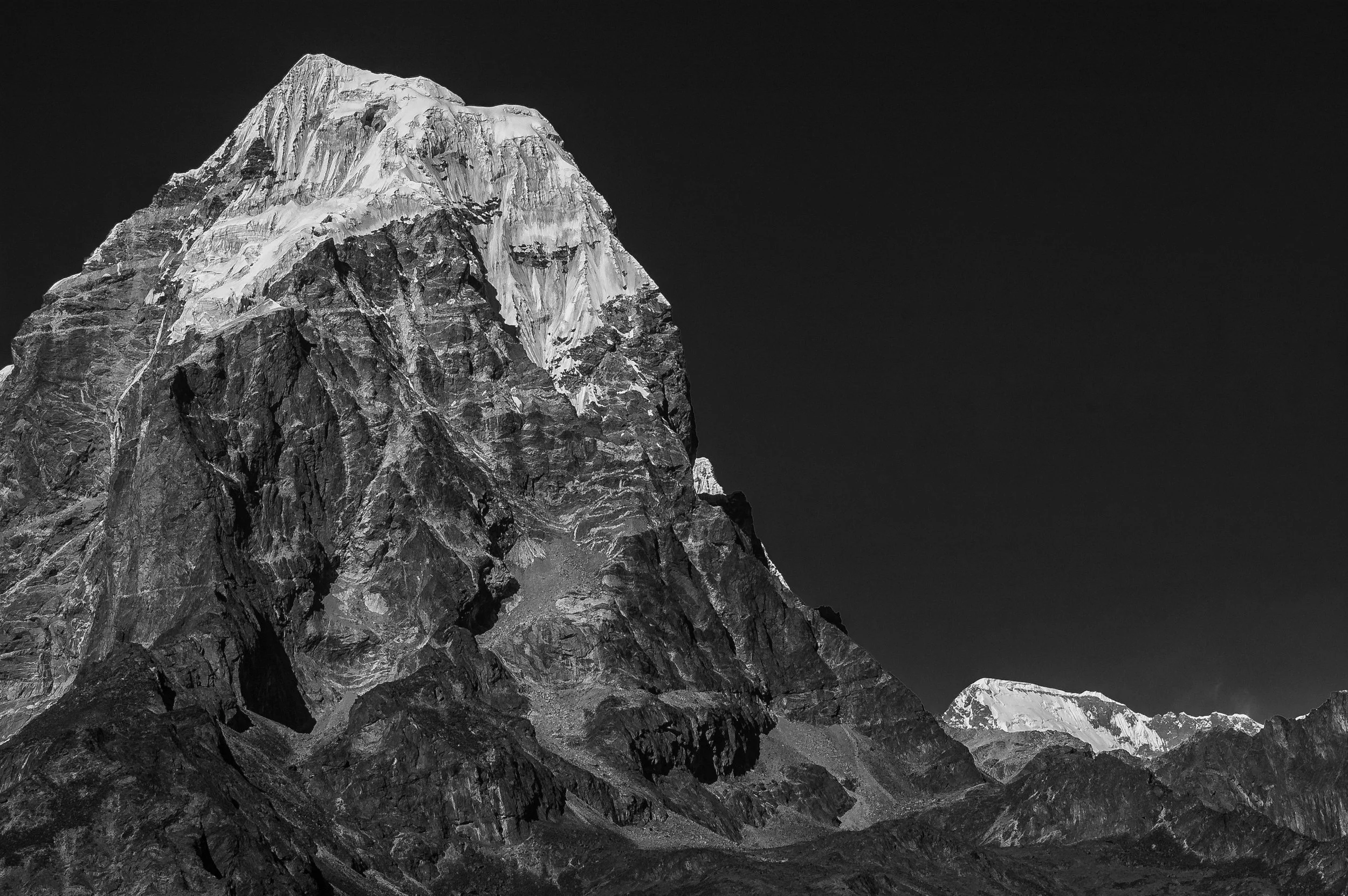
Until We Act, the Mountains Will Keep Changing
A three-year climate & culture archive capturing Nepal’s aerial truth in black-and-white fine art.
Take your production higher.