
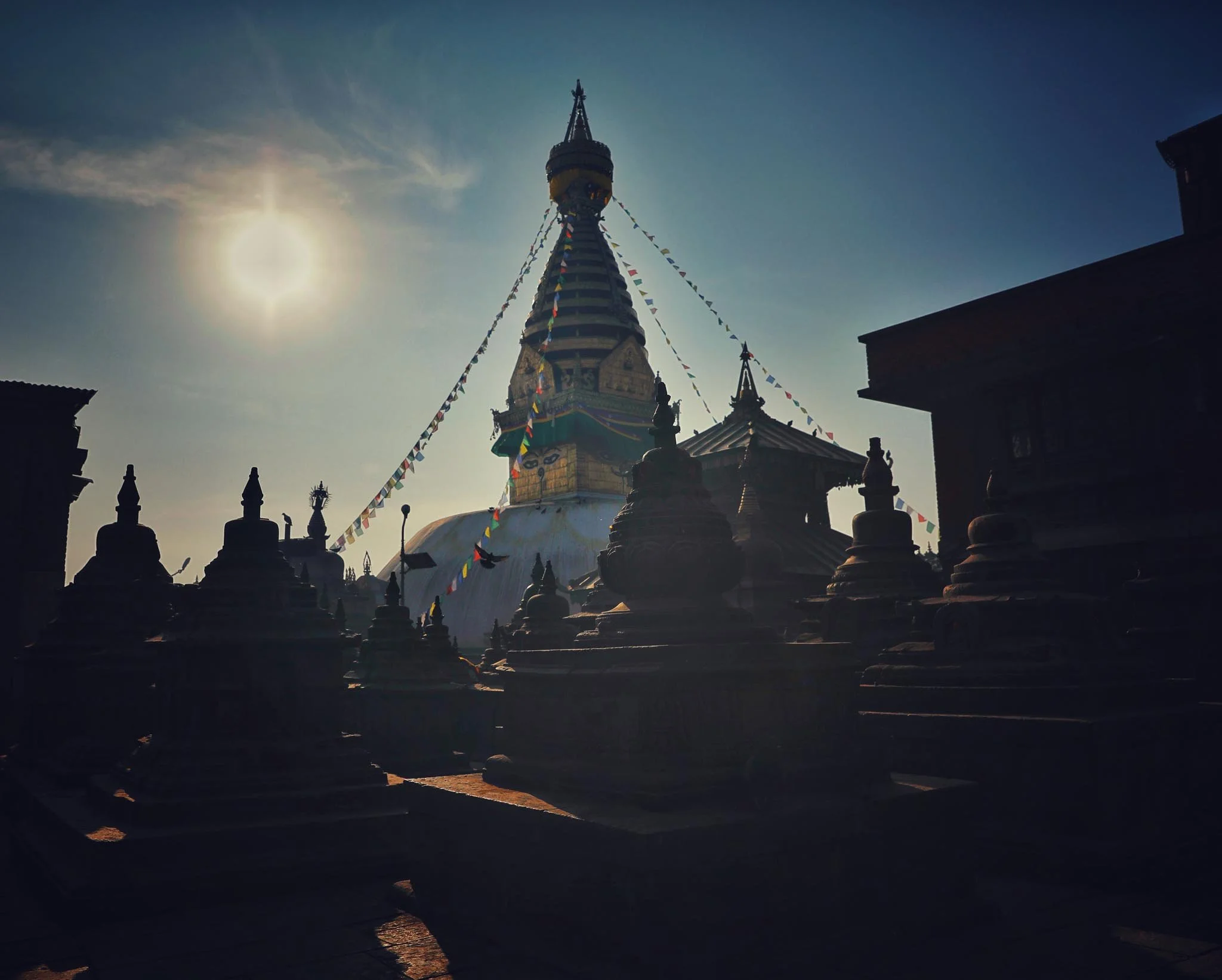
Film, Television & Photography Production inside UNESCO Heritage Sites in Nepal
UNESCO HERITAGE SHOOTS NEPAL
FILMING WHERE HISTORY IS STILL ALIVE.
UNESCO HERITAGE · MONUMENTS · TEMPLES · MONASTERIES · PALACES · LIVING CULTURE · PEOPLE · TRADITIONS · ARTIFACTS · DOCUMENTARY · FILM · PHOTOGRAPHY
Nepal's heritage is not confined to monuments.
It lives in courtyards, monasteries, streets, festivals, rituals, architecture, craftsmanship, communities and generations of people who continue to live within it.
For international filmmakers, photographers, broadcasters, brands, researchers and storytellers, that creates extraordinary possibilities.
It also creates responsibility.
Location Nepal helps you work within that balance.
MORE THAN A UNESCO SITE
THE REAL HERITAGE IS MUCH BIGGER.
Kathmandu Valley. Lumbini. Sagarmatha. Chitwan.
And beyond the formal UNESCO designation: historic cities, Durbar Squares, temples, monasteries, sacred sites, traditional settlements, ethnic communities, living traditions, festivals, crafts, objects, architecture and landscapes shaped by centuries of human activity.
You may come looking for a World Heritage Site. You may leave with an entire visual world.
THE FIRST QUESTION IS NOT “CAN WE SHOOT HERE?”
IT IS “HOW SHOULD WE SHOOT HERE?”
Some locations are sensitive. Some are restricted. Some are active places of worship. Some are living communities. Some contain irreplaceable architecture and objects.
Some simply cannot be treated like a conventional film set.
We begin with the location, the story, the crew, the equipment, the activity and the required permissions.
Then we build the production around what the place can responsibly accommodate.
PERMITS ARE PART OF THE PRODUCTION
NOT SOMETHING TO FIGURE OUT ON THE MORNING OF THE SHOOT.
Heritage filming can involve multiple authorities, conservation bodies, local offices, site management, community considerations and specific restrictions.
Location Nepal handles the Nepal-side research, applications, coordination and production communication required for the project.
The paperwork matters because the place matters.
HANDLE WITH CARE
THE CREW NEEDS TO KNOW WHERE THE LINE IS.
Where can equipment stand?
Where can a camera move?
Can lighting be used?
Can a tripod be placed?
Can a scene be dressed?
Can an actor enter?
Can crowds be managed?
Can a vehicle approach?
Can a drone operate?
These questions are addressed before production reaches the location.
Respect is part of the call sheet.
WHEN THE SCRIPT NEEDS THE LOCATION TO BECOME A SCENE
HERITAGE DOES NOT HAVE TO MEAN STATIC.
A television drama may need actors moving through a courtyard.
A feature film may need a period scene.
A commercial may require hundreds of people.
A documentary may need access to people, rituals and working spaces.
A photograph may need nothing more than the right moment and the right light.
We work out what the story requires without losing sight of what the location requires.
DOCUMENTARY. DRAMA. FEATURE. SHORT. COMMERCIAL.
HORIZONTAL. VERTICAL. STILL IMAGE. MOVING IMAGE.
There is no single “heritage shoot”.
Feature films, television series, documentaries, commercials, branded content, editorial photography, fashion, journalism, social content, research documentation and independent projects can all require very different approaches.
The format changes. The care does not.
WHEN THE LOCATION IS ALREADY LIVING
PEOPLE ARE NOT BACKGROUND.
A monastery is not simply architecture.
A festival is not simply colour.
A village is not simply a location.
A ritual is not simply a scene.
We help productions navigate the practical and cultural considerations of working with people, communities, performers, monks, artisans and local participants.
Authenticity begins with how you work, not just what the camera records.
CREATE THE SCENE. PROTECT THE PLACE.
SOMETIMES THE CAMERA NEEDS MORE.
Costumes. Props. Extras. Set dressing. Controlled movement. Art direction. Temporary elements. Crowd management.
Location Nepal can coordinate the production requirements needed to create a scene while keeping the heritage environment and its restrictions in the planning conversation.
The objective is not to make the location behave like a studio.
It is to make the production work within the location.
A LOCATION CAN BE BEAUTIFUL AND STILL BE DIFFICULT
THAT IS WHY SCOUTING MATTERS.
Access. Parking. Power. Equipment movement. Crowds. Sound. Light. Weather. Opening hours. Religious activity. Nearby accommodation. Transport. Security. Permissions.
We look at the photograph and the production operation at the same time.
THE HERITAGE MAY BE THE STORY
OR IT MAY BE THE WORLD AROUND IT.
A campaign can use architecture without becoming a heritage campaign.
A feature can use a historic city as another period.
A documentary can follow a community rather than a monument.
A fashion production can use ancient textures against contemporary design.
A photographer can find an entirely different visual language in a centuries-old environment.
Heritage is not one genre. It is a resource for many stories.
KATHMANDU VALLEY IS ONLY THE BEGINNING
THEN THE COUNTRY OPENS UP.
Historic Kathmandu, Patan and Bhaktapur.
Lumbini and its Buddhist heritage.
Mountain monasteries.
Traditional Newari settlements.
Rural architecture.
Sacred landscapes.
National parks.
Ancient trade routes.
Remote Himalayan communities.
Living cultural traditions across Nepal's many ethnic and linguistic communities.
The further you travel, the more the definition of heritage changes.
REAL PRODUCTIONS. REAL HERITAGE. REAL PRESSURE.
WE HAVE ALREADY BEEN HERE.
For Nippon Paint, Location Nepal coordinated a major one day commercial across Bhaktapur Durbar Square and Patan Durbar Square, involving more than 300 professional crew and 500 extras, with costumes, art direction, crowd management and complex heritage-site coordination.
China Postal Express was filmed entirely in historic Bhaktapur, including Bhaktapur Durbar Square and Nyatapola Temple, requiring location management, permits, equipment, transport and an all-Nepali cast and crew.
Joia Rara, the Brazilian television series, combined Nepal's cultural and spiritual environments with large scale international production, including Brazilian, Indian and Nepali teams, historical sets, costumes, props and hundreds of local extras.
Gap Year, produced for Channel 4, used Nepal's cultural and spiritual environments alongside its wider landscapes, with Location Nepal handling locations, permits, crew, equipment and logistics.
Samsonite used an entirely different visual language, moving from Kathmandu's historic architecture through mountain villages, the plains and high-altitude Thorong Pass in Manang.
And CELCOM combined Bhaktapur architecture, Boudhanath, monasteries, Mustang and Manang into a single commercial production.
Different stories. Different countries. Different production pressures. The same Nepal-side experience.
WHEN THE WORLD IS WATCHING
THE PRODUCTION HAS TO WORK BEHIND THE CAMERA TOO.
International directors. Agency teams. Brand representatives. Broadcasters. Photographers. Producers. Journalists. Researchers. Actors. Large crews. Small crews.
Sometimes several countries working together.
Location Nepal becomes the Nepal-side bridge between the creative brief and the realities of the location.
FROM ONE CREW TO HUNDREDS
HERITAGE DOES NOT ALWAYS MEAN SMALL.
Some projects need a photographer and a fixer.
Others need hundreds of crew, extras, transport vehicles, equipment, art departments, costumes, security and multiple production units.
Our experience includes both.
The scale of the production changes. The planning does not.
THE DETAILS AROUND THE SHOOT
BECAUSE HERITAGE PRODUCTIONS STILL NEED A PRODUCTION.
Location scouting. Permits. Liaison. Local fixers. Crew. Equipment. Customs. Transport. Accommodation. Catering. Casting. Extras. Art department. Security. Communications. Schedule management. Remote logistics.
And where required, specialist personnel from Nepal or other production markets.
We build what your production needs around the location.
WHEN THE CAMERA NEEDS TO FLY
AERIAL WORK REQUIRES ANOTHER LAYER OF PLANNING.
Drones and other aerial operations around heritage environments are not simply a matter of arriving with equipment.
Applicable aviation, heritage, location and operational permissions need to be considered together.
If the shot requires the sky, we plan for the sky too.
WHEN THE STORY NEEDS NEPAL, NOT A SET
THAT IS WHERE THE COUNTRY BECOMES EXTRAORDINARY.
You can construct a palace.
You can dress a street.
You can recreate a monastery.
But there are places in Nepal where centuries of architecture, culture, landscape and human activity already exist together.
Sometimes the most ambitious production design is simply finding the right place.
THE PRODUCTION BACKBONE
EXPERIENCE MATTERS WHEN THE LOCATION CANNOT BE REPLACED.
Location Nepal's production heritage extends through Films & AdFilms, its parent company, with a history spanning generations of Nepalese film production.
Today, Gautam Dhimal brings experience across photography, filmmaking, production management, location work and international productions into that wider operation.
That combination matters particularly when creative ambition meets a location that requires patience, precision and practical judgement.
WHEN YOU NEED SOMEONE WHO UNDERSTANDS BOTH SIDES
THE CREATIVE SIDE AND THE PRODUCTION SIDE.
A heritage production needs more than someone who knows where the monument is.
It needs someone who understands the script, the camera, the crew, the client, the permissions, the local environment and the practical consequences of every production decision.
That is where experience becomes useful.
WHAT ARE YOU LOOKING FOR?
A MONUMENT? A CITY? A MONASTERY? A COMMUNITY? A PERIOD? A STORY?
Tell us what you have in mind.
A script. A treatment. A documentary proposal. A photography brief. A storyboard. A reference image.
Or simply the question:
“Could we shoot this in Nepal?”
We can begin there.
FREQUENTLY ASKED QUESTIONS
Can Location Nepal arrange permits for UNESCO heritage sites?
Yes. Location Nepal can research, coordinate and manage applicable filming permissions and related government and heritage authorities for productions in Nepal.
Can you film inside UNESCO World Heritage locations?
Potentially, subject to the applicable permissions, site rules, conservation requirements, timing and nature of the production. Each location and activity must be assessed individually.
Do you only work with UNESCO World Heritage Sites?
No. The scope is much wider. We work with historic monuments, temples, monasteries, palaces, traditional settlements, cultural landscapes, communities, festivals, living traditions and other heritage environments across Nepal.
Can we film in temples and monasteries?
Potentially, depending on the site, religious function, activity, permissions and production requirements. Sacred spaces require particularly careful planning and respectful conduct.
Can we stage scenes inside heritage locations?
Where permitted, yes. The production can be planned around the site's restrictions, including actors, extras, costumes, props, art direction and camera requirements.
Can we bring large crews into heritage locations?
Potentially, subject to site capacity, permissions, timing and restrictions. Large productions require additional planning for crowd movement, equipment, access, security and conservation considerations.
Can you arrange local extras and performers?
Yes. Local casting, extras and community participation can be coordinated where appropriate to the story and location.
Can you help with cultural liaison?
Yes. Local liaison and cultural understanding can be incorporated into the production, particularly where filming involves communities, religious spaces, festivals or living traditions.
Can you film festivals and cultural events?
Potentially, yes. The requirements depend on the event, location, activity, crowd conditions and permissions. Timing and cultural sensitivity are particularly important.
Can we bring foreign actors and crew?
Yes. International cast and crew can work in Nepal subject to the applicable production, travel, immigration and filming requirements.
Can you arrange accommodation and transport?
Yes. Transport, accommodation, catering and other production logistics can be arranged according to the scale and location of the project.
Can you handle equipment brought from abroad?
Yes. Equipment importation, customs coordination and local equipment requirements can be incorporated into production planning.
Can you provide local film equipment?
Yes. Equipment requirements can be sourced and coordinated according to the production.
Can you support documentary photography as well as film?
Yes. The same production infrastructure can support still photography, documentary photography, editorial work, branded content, television, feature films and other visual formats.
Can we shoot vertical content?
Yes. Heritage production is not limited to traditional cinema or horizontal television. Vertical campaigns, social content and mobile-first productions can also be planned around appropriate locations and permissions.
Can you arrange drone filming at heritage locations?
Potentially, subject to applicable aviation, location and heritage permissions and operational requirements. Drone operations are assessed separately from ground filming.
Can you work outside Kathmandu Valley?
Yes. Location Nepal works across Nepal, including the Terai, hills, national parks, mountain regions and remote Himalayan areas, subject to access, permits, season and production requirements.
Can you recreate another country or historical period in Nepal?
Potentially, yes. Nepal's architecture, landscapes and cultural environments can sometimes stand in for other geographies or periods, with location selection, art direction, props, costumes and production design working together.
Do you handle post-production?
No. This page focuses on location research, pre-production, permits, production and Nepal-side execution. Post-production is outside this service scope.
HERITAGE IS WAITING.
THE QUESTION IS WHAT YOU WANT TO DO WITH IT.
A documentary. A feature. A commercial. A fashion film. A television series. A photographic story. A research project. A vertical campaign.
Or something nobody has made here before.
Bring us the idea. We'll help you understand what Nepal can make possible.